
The New Era of Digital Exploration
Walking through a luxury apartment in Tokyo while sitting on a sofa in London was once the stuff of science fiction. Today, it is a standard business practice driven by the rapid evolution of artificial intelligence.
Virtual tours have transitioned from grainy, static photos to fluid, three-dimensional experiences. AI has simplified this complex process, allowing creators to build immersive environments without needing a degree in computer science.
For modern content architects, understanding these tools is no longer optional. It is the key to providing a sense of presence and scale that traditional photography simply cannot match in a digital space.
In this guide, we will explore how AI is reshaping the virtual tour landscape. We will move from basic asset gathering to the sophisticated deployment of digital twins for various industries.
The Shift from Manual Stitching to AI Automation
In the early days of virtual tours, photographers had to manually align dozens of images. This process was much like trying to solve a massive jigsaw puzzle where the edges of the pieces were slightly blurry.
AI has effectively solved this problem through automated image stitching. Machine learning algorithms now identify overlapping patterns with sub-pixel precision, creating seamless 360-degree views in a fraction of the time.
Beyond simple alignment, AI handles exposure correction and color balancing. If one side of a room is bathed in sunlight and the other is in shadow, the AI flattens these discrepancies for a natural look.
This automation allows creators to focus on the narrative of the tour rather than the technical minutiae. It turns a labor-intensive technical task into a streamlined, creative workflow that anyone can master.
Core Technologies Powering Modern Tours
The real magic happens behind the scenes with technologies like Neural Radiance Fields, commonly known as NeRFs. These models can take a few standard 2D photos and predict what the 3D space between them looks like.
Another rising star is Gaussian Splatting. This technique allows for incredibly fast rendering of complex reflections and lighting, making a virtual space feel physically tangible to the viewer.
AI Insight: These technologies do not just capture images; they capture the way light interacts with surfaces, creating a ‘living’ digital replica.
By using these AI-driven methods, you move away from ‘flat’ 360 photos toward ‘volumetric’ spaces. This means users can move forward, backward, and around objects, rather than just spinning in a single fixed circle.
Step-by-Step: Building Your First AI-Enhanced Tour
1. Asset Collection and Preparation
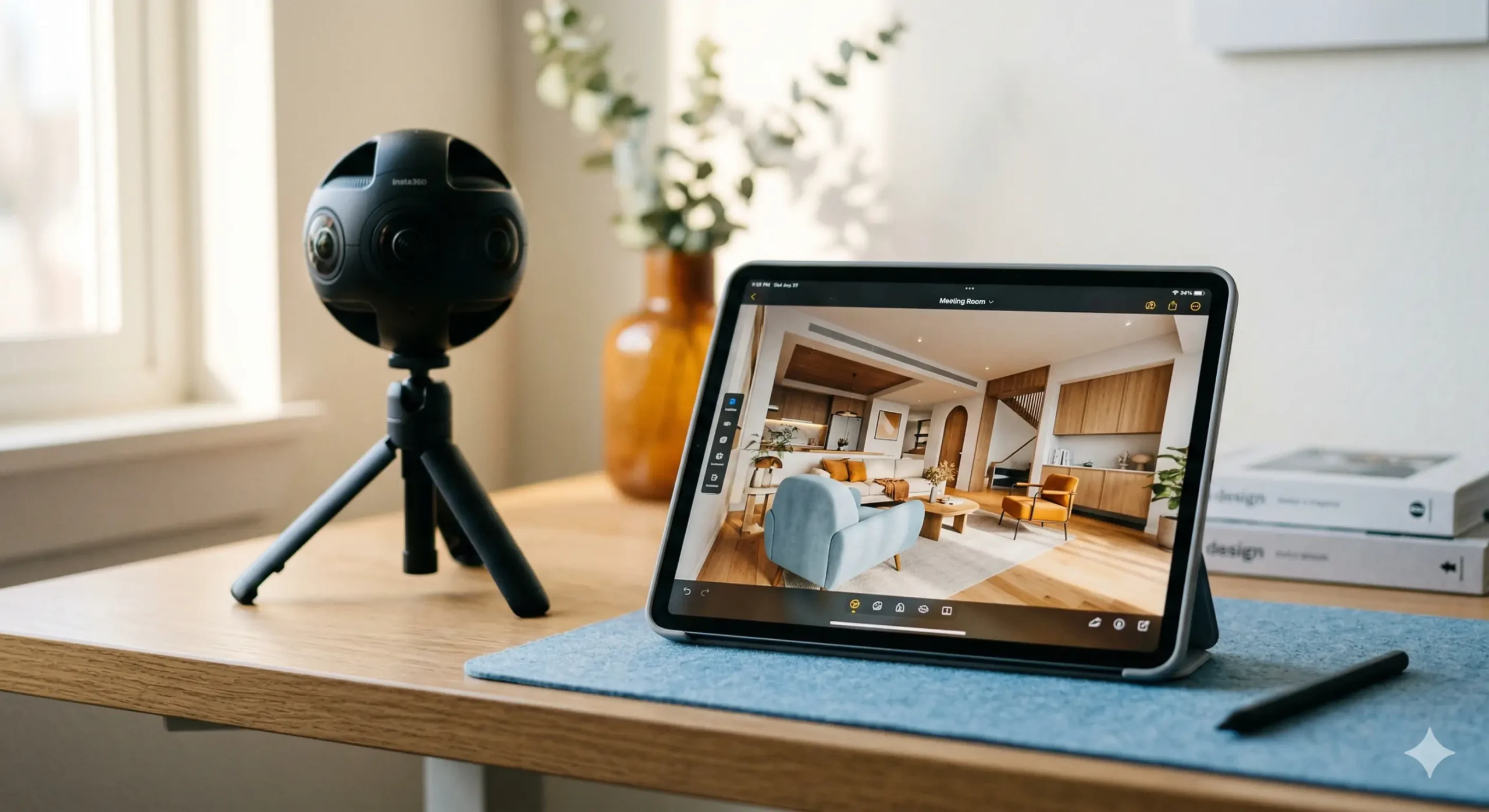
Start by capturing your environment using a 360-degree camera or even a standard smartphone with a dedicated app. The goal is to get as much visual data as possible from different angles.
AI upscaling tools can be used at this stage to enhance the resolution of your raw files. This ensures that when a user zooms in on a specific detail, the image remains crisp and professional.
Consider the lighting as your primary narrator. While AI can fix many errors, starting with a clean, well-lit space will always yield a more realistic and inviting final product for your audience.
2. The AI Reconstruction Phase
Upload your images to a platform that utilizes 3D reconstruction. The AI will analyze the depth of the room, creating a ‘mesh’ or a skeleton of the physical environment.
During this phase, the software often removes unwanted artifacts, such as the reflection of the camera in a mirror. This ‘inpainting’ capability is one of the most useful features of modern AI suites.
This stage transforms a collection of flat images into a cohesive spatial map. It is the moment your project stops being a photo gallery and starts becoming a navigable world.
3. Adding Interactive Layers
An empty room is just a shell; interactivity gives it purpose. Use AI to generate ‘hotspots’ that provide information about specific items or features within the tour.
AI voiceover tools can provide professional narration in multiple languages, making your tour accessible to a global audience. You can script these guides to change based on user behavior.
Integrating AI-powered chatbots within the tour can also help. Imagine a prospective homebuyer asking, ‘What is the square footage of this kitchen?’ and receiving an instant, accurate response.
Comparing Traditional and AI-Driven Methods
The difference between the old way and the AI way is stark. To help visualize this, let us look at how these two approaches stack up against each other in a professional environment.