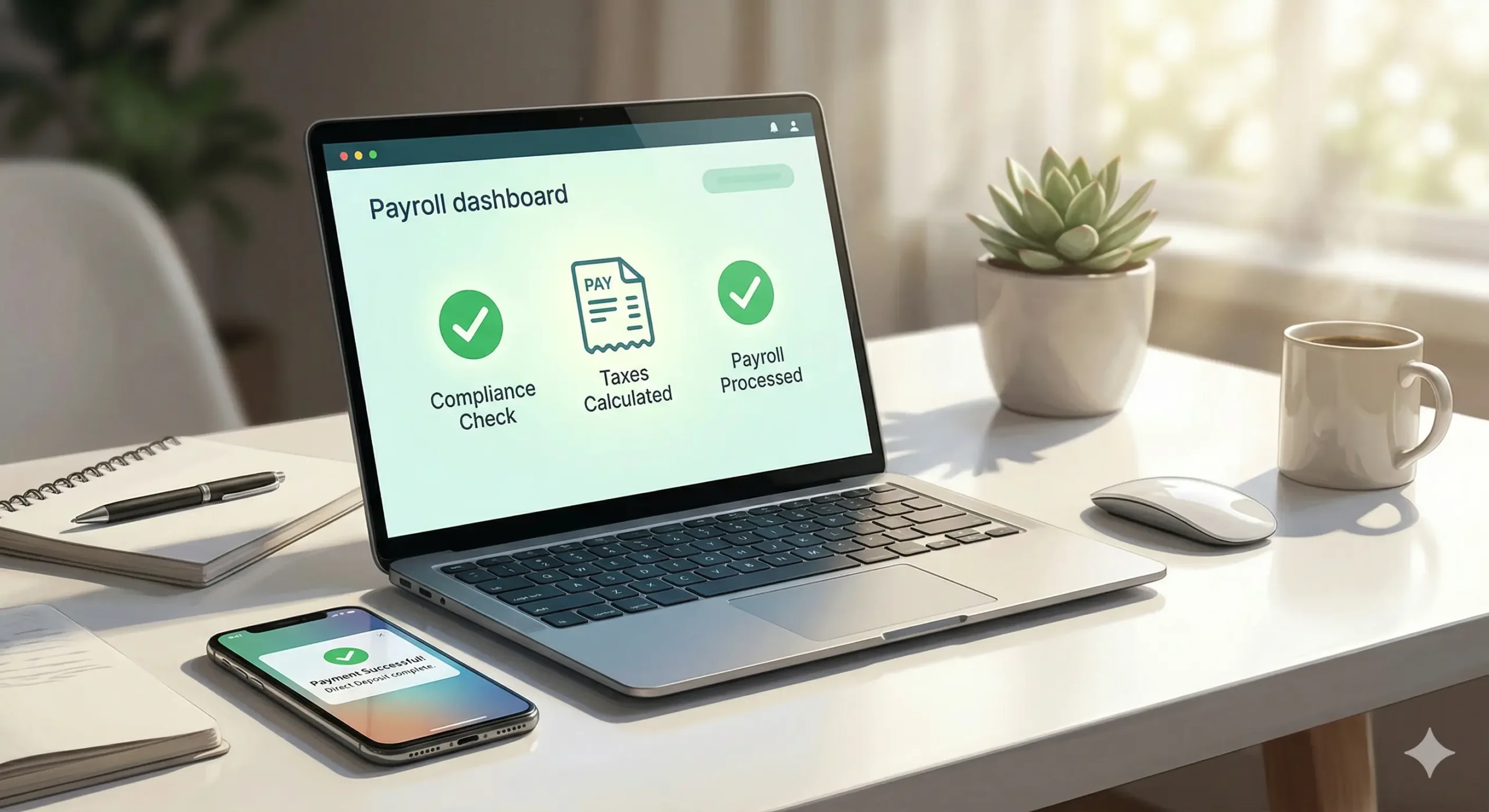
The End of the Payroll Headache
Let’s be honest: very few business owners started their company because they had a passion for calculating tax withholdings. For decades, payroll has been the silent weight on the shoulders of HR departments and small business owners alike.
It is a process defined by high stakes and low room for error. One misplaced decimal point can lead to a frustrated employee or a complicated audit. However, as we move through 2026, the landscape has shifted dramatically thanks to Artificial Intelligence.
AI isn’t just a buzzword in the fintech space; it is a practical, silent hero. It has moved payroll from a manual, spreadsheet-heavy chore to a streamlined, automated system that almost manages itself.
In this guide, we will explore how AI tools are taking the guesswork out of payments, ensuring everyone gets paid correctly and on time, while you get your Sundays back.
The Shift from Manual Entry to Intelligent Flow
Traditional payroll relies on manual data entry—a process as old as commerce itself. You collect hours, calculate deductions, check for overtime, and cross your fingers that the tax laws haven’t changed since last month.
AI tools change the game by integrating directly with your time-tracking and banking software. Instead of you pushing data from one app to another, the AI pulls it through a seamless, intelligent flow.
Think of it like a self-cleaning kitchen. The system notices when an employee clocks in late, adjusts the pay accordingly, and flags any inconsistencies for your review before the final ‘send’ button is ever pushed.
This reduces the “human touchpoints” where errors usually occur. By removing the need for manual transcription, you effectively eliminate the risk of the dreaded “fat-finger” typo that causes so much grief.
How AI Catches What We Miss
One of the most impressive features of modern AI payroll systems is anomaly detection. Human eyes get tired after looking at three hundred rows of data; an AI algorithm never blinks.
If an employee who usually works 40 hours suddenly has a 100-hour week logged, the AI identifies this as an outlier immediately. It doesn’t just process it; it asks, “Is this correct?”
This predictive capability also extends to compliance. Tax laws are notoriously fickle, and keeping up with regional changes can feel like a full-time job in itself. AI tools update their internal logic in real-time as new regulations are passed.
Whether it is a change in local income tax or a new health insurance mandate, the AI adjusts the calculations automatically. This provides a layer of legal security that is virtually impossible to achieve manually.
The Power of Employee Self-Service
AI tools have also revolutionized how employees interact with their own pay. We are moving away from the era of emailing HR to ask for a copy of a W-2 or to check how much vacation time is left.
Modern platforms use Natural Language Processing (NLP) to power internal chatbots. An employee can simply ask, “Why is my check different this month?” and the AI can explain the specific deduction or tax change in plain English.
This empowers your team and significantly reduces the administrative burden on your HR staff. It turns a mystery into a transparent, accessible conversation for everyone involved.
A Comparison of Traditional vs. AI-Powered Payroll
| Feature | Traditional Manual Payroll | AI-Automated Payroll |
|---|---|---|
| Processing Time | Several days per month | Minutes of oversight |
| Error Rate | Moderate (Human error) | Near-Zero (Anomaly detection) |
| Tax Compliance | Manual research and updates | Automatic real-time updates |
| Employee Support | Manual HR responses | Instant AI-driven chatbots |
Micro-Case: The Scaling Startup
Consider the case of ‘Nova Tech Solutions,’ a mid-sized firm that grew from 10 to 85 employees in a single year. Their original manual payroll system was buckling under the pressure, requiring their founder to spend 15 hours a week on admin.
After switching to an AI-driven platform, that time dropped to just 45 minutes of review per week. The AI caught three major tax filing errors in the first month alone, saving the company an estimated $4,000 in potential penalties.
The Future: Global Payroll and Beyond
As remote work becomes the standard, many companies find themselves hiring talent in different countries. Managing a global payroll manually is a logistical nightmare involving various currencies and international laws.
AI tools are the bridge over these waters. They can handle cross-border payments with ease, calculating the correct exchange rates and ensuring compliance with foreign labor laws automatically.
In the coming years, we expect to see even more integration with financial wellness tools. AI will be able to offer employees personalized advice on tax savings or retirement contributions based on their actual take-home pay.
The goal is no longer just to “pay people.” It is to provide a comprehensive financial ecosystem that supports the employee while protecting the business from unnecessary risk.
Tips for Successful AI Implementation
- Clean Your Data: Before plugging in an AI tool, ensure your existing employee records are accurate. AI is powerful, but “garbage in, garbage out” still applies.
- Integrate Your Apps: Choose a tool that talks to your existing accounting and time-tracking software to maximize the automation benefits.
- Keep a Human in the Loop: While AI is highly accurate, always have a human manager perform a final high-level review of the payroll summary.
- Train Your Team: Show your employees how to use the self-service features. The more they use the AI, the more time your HR team saves.
Choosing the Right Tool for Your Scale
Not every AI payroll tool is right for every business. Some are built for the simplicity of a five-person shop, while others are designed for the complexities of a multinational corporation.
When exploring options, look for “scalability.” You want a tool that can grow with you. It is much easier to upgrade your plan than it is to switch your entire payroll database to a new provider two years down the line.
Security should also be a top priority. Ensure any tool you use utilizes enterprise-grade encryption. Payroll data is some of the most sensitive information your company holds, and it must be guarded accordingly.
Lastly, consider the user experience. If the dashboard is too complex, your team won’t use the self-service features, and you’ll end up back in the cycle of manual answering.
Conclusion: Embracing the Modern Payday
Automating your payroll with AI isn’t just about following a trend; it’s about building a more resilient and efficient business. It allows you to shift your focus from back-office logistics to front-line growth.
By delegating the repetitive, high-stakes math to intelligent systems, you create a more professional experience for your employees and a more peaceful environment for yourself.
Payday should be a day of celebration, not a day of stress. With the right AI tools, you can ensure that it stays that way for years to come. Thank you for staying informed with us here at livetrackersxyz.com.